Night-time aeration in conventional sea cucumber ponds depends on manual work, which is labour-intensive and carries real safety risk. This system delivers unattended aeration at very low cost, upgrading the conventional pontoon-and-aerator arrangement into an intelligent aeration unit with autonomous navigation and path planning, removing manual labour from the process and improving pond returns.
View SpecificationsAn intelligent automatic aeration solution engineered for sea cucumber pond culture
Conventional sea cucumber pond culture relies on a pontoon plus aerator. Night after night, when dissolved oxygen in the pond reaches its daily minimum in the small hours, an operator must pole a boat out or wade in and run the pontoon and aerator in complete darkness. The work is physically demanding, hazardous and inefficient, and it has become the key constraint on pond profitability.
The system was developed directly against this problem. At very low cost it upgrades conventional equipment into an automated aeration system with autonomous navigation and path planning. At its core is an intelligent control unit that combines high-precision positioning with route recording to deliver a complete automated cycle: one-button start, automatic pond patrol and intelligent aeration.
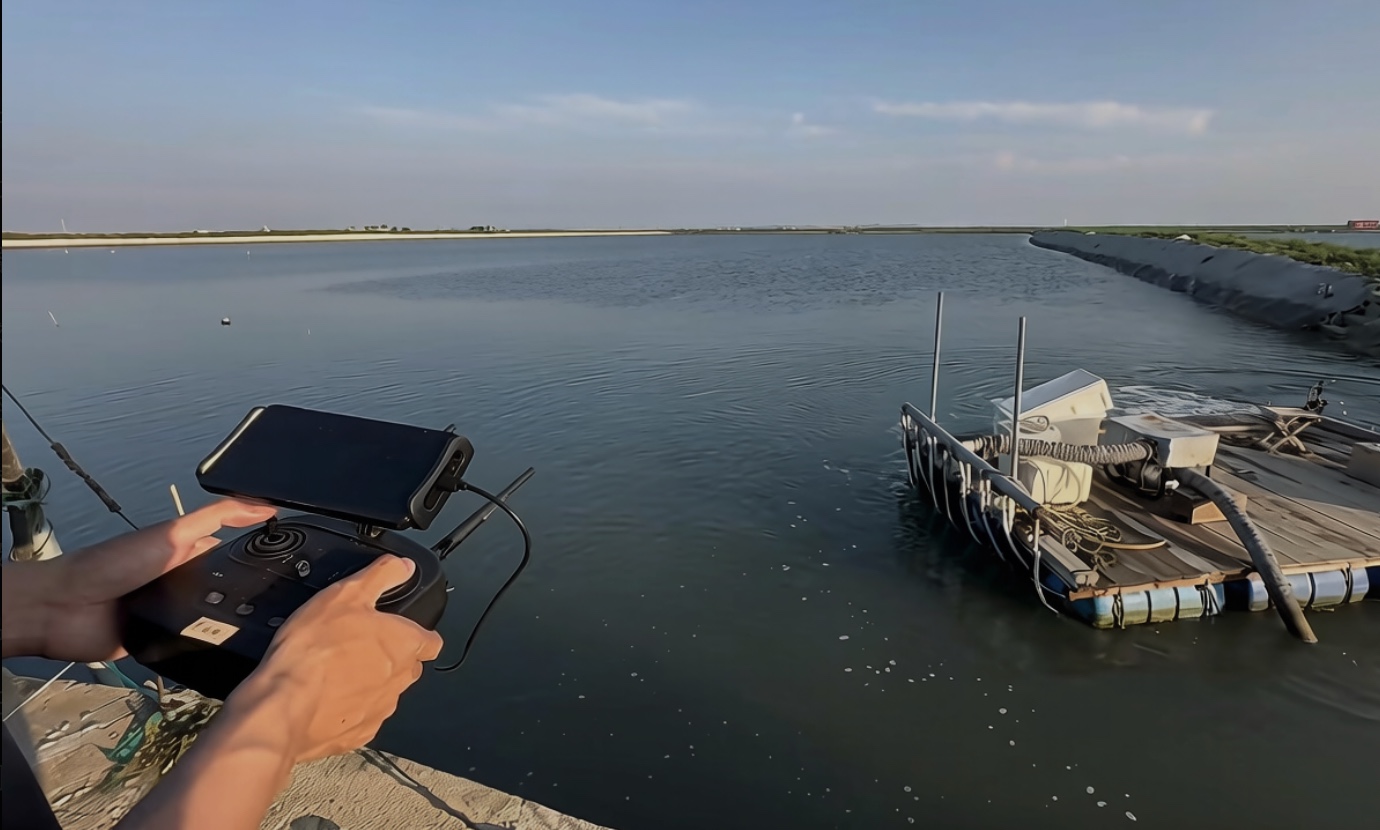
The system in operation in sea cucumber ponds
Installation and route recording
Automatic aeration in operation
The difference between conventional practice and the intelligent system
Manual work in the small hours; heavy physical demand
Safety hazards and a real risk of accidents
Heavy dependence on labour; low efficiency
Delayed aeration that costs yield
Operations become difficult in bad weather
Runs automatically around the clock; manual work eliminated
No night-time work at all; a high safety margin
One-button remote start; simple management
Timely, accurately targeted aeration that lifts yield
Continues to operate in bad weather
The operational capabilities the system brings to pond management
The operator drives the route once by hand and the system records it precisely. From then on a single command sends the pontoon along the recorded route for unmanned aeration.
A built-in high-precision positioning receiver samples position continuously so that successive runs follow the same line. Non-volatile memory retains the pond route permanently; power loss does not erase it.
A wireless link allows position and operating status to be monitored from a phone or computer, and start, pause or return-to-base commands to be issued, so aeration can be managed from anywhere.
Industrial relays keep the electrical circuit stable and a sealed enclosure withstands the damp environment. The control box drives the steering actuator to hold course while the aerator is switched in step with travel.
Power can come from a battery alone, or from a battery backed by a fuel generator, giving ample capacity for long uninterrupted aeration and true round-the-clock operation.
Aerator start and stop are controlled precisely by preset programme or remote command and synchronised with pontoon travel, so that oxygen is distributed evenly across the pond.
Detailed parameters for the smart aeration system
Applications across aquaculture
Purpose-designed for sea cucumber ponds, it removes the night-time aeration problem, improves survival and growth rates, and lowers both cost and risk.
Suited to shrimp ponds, it aerates to a set schedule and volume, holding dissolved oxygen steady and supporting healthy growth.
In crab ponds it patrols and aerates automatically, reducing manual intervention and improving both management efficiency and returns.
Applicable to finfish farms of all kinds, it brings intelligent aeration management, improves water quality and raises both output and product quality.
